
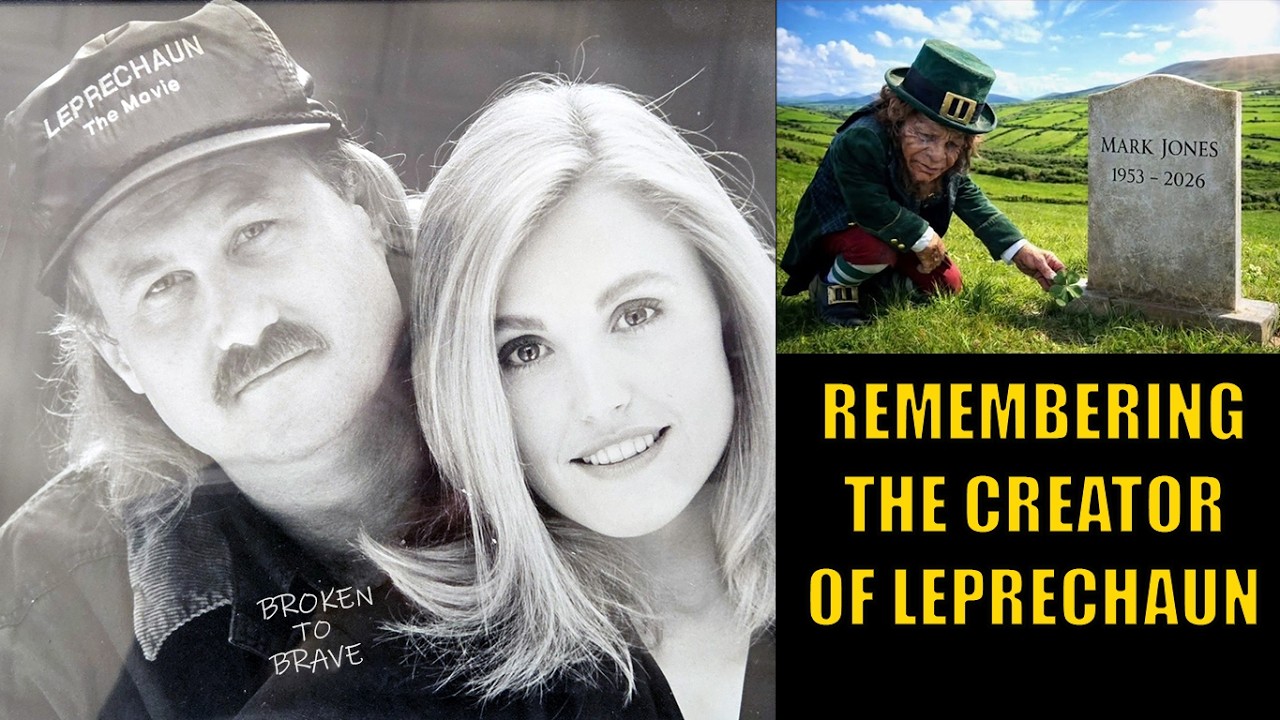
An intimate Broken to Brave podcast conversation about friendship, creativity, Hollywood history, grief, and the complicated legacy of writer-director Mark Jones.
Who was Mark Jones? Mark Jones was the writer-director who created the cult horror-comedy Leprechaun and built a wide-ranging career across animation, network television, and independent film. In this conversation, Donna Barnes and George Saadi remember the private person behind the credits: inventive, funny, guarded, stubborn, generous, and deeply important to the people who knew him.
At a Glance
- Mark Jones wrote and directed the 1993 cult film Leprechaun, launching a lasting horror franchise.
- Before feature films, he wrote for animation and television, including projects connected with Scooby-Doo, Super Friends, The A-Team, and The Fall Guy.
- Donna Barnes and George Saadi knew Jones in different decades and describe the same mix of humor, privacy, creativity, and strong opinions.
- Their memories also explore an intense former relationship, mentorship in old Hollywood, delayed healthcare, grief, and the new friendships that can follow loss.
A Friendship Formed in the Wake of Loss
Donna Barnes opens with an idea that frames the entire conversation: life keeps unfolding while we are making other plans. The death of someone central can reorder a life, but it can also introduce people who might never otherwise have met. That is how Barnes came to know George Saadi. Both were close to Mark Jones—Barnes as a former partner who became a lifelong friend, and Saadi as one of Jones’s closest companions later in life.
Their recollections are not a conventional filmography. They offer something more personal: an oral history of the creative mind behind Leprechaun, told by two people who saw his warmth, contradictions, ambition, and vulnerability away from the set.
Who Was Mark Jones?
Mark Robert Jones (1953–2026) was an American writer, director, and producer whose career crossed Saturday-morning animation, prime-time television, and independent features. He began in animation, writing for studios including Filmation, DePatie-Freleng, and Hanna-Barbera. His credits included work associated with Mister Magoo, The Pink Panther, Super Friends, and Scooby-Doo.
Jones later moved into live-action television, contributing to series such as The Fall Guy, The A-Team, Knight Rider, and Superboy. He became best known for writing and directing Leprechaun, the horror-comedy starring Warwick Davis and featuring an early film role for Jennifer Aniston. He also wrote and directed Rumpelstiltskin and continued making genre films including Triloquist and Scorned.
Donna Barnes on Loving—and Leaving—Mark Jones
Barnes describes an immediate creative affinity with Jones, but also a relationship that was often combustible. They could be funny together and fiercely connected, yet their differences repeatedly turned small moments into arguments. She recalls Jones as guarded in public and highly conscious of image, while she was naturally open and inclined to talk to strangers.
Barnes also speaks candidly about dynamics she experienced as emotionally damaging and about the way conflict affected her focus as a working actor. With time, she concluded that Jones’s behavior often came from insecurity rather than a calculated desire to undermine her. That distinction did not erase the harm, but it helped her understand it. Leaving Los Angeles created the distance they needed, and friendship ultimately proved healthier than romance.
A turning point came when television producer Glen A. Larson—Jones’s mentor and Barnes’s trusted friend—invited her to lunch. As Barnes remembers it, Larson told her plainly that although he loved Jones too, the relationship was not good for her. She describes that conversation as the permission she needed to move forward.
How George Saadi Met Mark Jones
Saadi first encountered Jones at a cigar lounge, where Jones had arrived with actor Scott Baio. A casual conversation turned into a group sushi dinner after Saadi offered to pay—and Jones and Baio jokingly invited everyone in the lounge. Saadi calls the oversized bill his “price of admission” to their circle.
Jones remained at arm’s length at first. Familiarity came through repetition: meals, travel, autograph events, long conversations, and time spent together. Saadi gradually became one of his dearest friends. Listening to Jones conduct business and decode movies gave Saadi what he calls an education by osmosis—the same feeling Barnes remembers from late-night conversations years earlier.
The Private Personality Behind a Public Career
Although Barnes and Saadi knew Jones in different eras, their descriptions align. He could be warm and compassionate with people he trusted, but skeptical of strangers and fiercely protective of his privacy. Both remember him questioning why they would strike up conversations in airports, stores, or restaurants. To them, meeting new people was a pleasure; to Jones, it could feel like an intrusion.
He was also funny, particular, and set in his ways. Barnes remembers a meticulously maintained hairstyle, a uniform-like wardrobe, and an insistence on projecting the image he wanted others to see. Saadi remembers the same guardedness, along with a dry sense of humor that made even difficult situations feel like material for a story.
Glen A. Larson, Mentorship, and Old Hollywood
Glen A. Larson, the prolific creator behind television series including Magnum, P.I., Knight Rider, and The Fall Guy, was both mentor and close friend to Jones. Barnes recalls being welcomed into the Larson household while working in Los Angeles and Palm Springs. Screenings, dinners, music, and long conversations created an informal education in how television was made and how creative careers were sustained.
Her stories evoke a vanished Hollywood ecosystem: film reels delivered for private screenings, a home bowling alley and recording space, a borrowed Porsche navigated with a Thomas Guide, and dinner tables where writers, producers, actors, musicians, friends, and people with nowhere else to go were all welcomed. For Barnes and Saadi, the most valuable part was access to the thinking behind the work.
Illness, Privacy, and a Difficult Goodbye
Saadi recounts taking Jones to the hospital for what Jones believed was a hernia. Doctors instead found cancer and other serious complications. On the evening before a planned procedure, Saadi left an overcrowded hospital room expecting to return the next day. Jones died that night, on January 16, 2026, one day before his 73rd birthday.
Both speakers believe Jones’s fear of doctors and desire for privacy made it harder for others to help. Their reflections are personal, not medical guidance, but the broader lesson is clear: fear, denial, and self-protective habits can isolate a person precisely when support matters most.
Grief Can Create New Connections
The conversation closes where it began: with the idea that loss changes the shape of a life. Barnes and Saadi met because Jones died, just as Jones’s later friendships had expanded after Larson’s death. Grief did not replace those relationships. It created room for the people left behind to compare memories, discover missing chapters, and understand someone they loved more fully.
Barnes remembers hearing “Wild World,” the song she associated with Jones, while friends gathered after his memorial. Saadi remembers bringing Jones’s ashes to the cigar lounge, placing a cigar beside them, and sharing a drink with the group. Both moments reflect a continuing bond: sorrow and humor occupying the same room, just as they had when Jones was alive.
What This Conversation Teaches About Love, Creativity, and Loss
- Love and compatibility are not the same. A powerful bond can be real even when a romantic relationship is unhealthy.
- Creative mentorship often happens informally. Meals, late-night conversations, and watching an expert work can teach what no classroom can.
- Privacy can become isolation. Protecting an image may prevent others from seeing when help is needed.
- Ideas require action. Talent can generate extraordinary possibilities, but fear and paralysis can keep them unrealized.
- Grief can widen a community. New relationships do not replace the person who died; they extend that person’s story.
Frequently Asked Questions
What is Mark Jones best known for?
Mark Jones is best known for writing and directing the 1993 horror-comedy Leprechaun, which launched a long-running franchise. He also worked extensively in animation and television.
Who are Donna Barnes and George Saadi?
Donna Barnes is a media personality, relationship coach, actor, and host of the Broken to Brave podcast who had a longtime personal connection with Jones. George Saadi was a close friend and collaborator of Jones in his later years.
What is this interview about?
The interview is a personal remembrance of Mark Jones. It covers his career, personality, friendships, relationship history, Hollywood mentors, final illness, and the ways people build new connections after loss.
When did Mark Jones die?
Mark Jones died in Los Angeles on January 16, 2026, at age 72—one day before his 73rd birthday.
What is the main takeaway from the conversation?
Its central message is that relationships can remain meaningful even when they are complicated, and that loss can connect people who carry different parts of the same person’s story.
Fact-Check Sources
Career and obituary details were cross-checked against reporting published by Variety and TheWrap, together with Mark Jones’s public film and television credits. Personal anecdotes and interpretations remain attributed to Donna Barnes and George Saadi.